
 3 months ago
72
3 months ago
72

SoftBank Stock (SFTBY) closed at $23.41 on June 18, holding above all major daily moving averages. The trend is unambiguously bullish. The question now is whether momentum can sustain the recent rally — or if consolidation is already beginning to take hold.
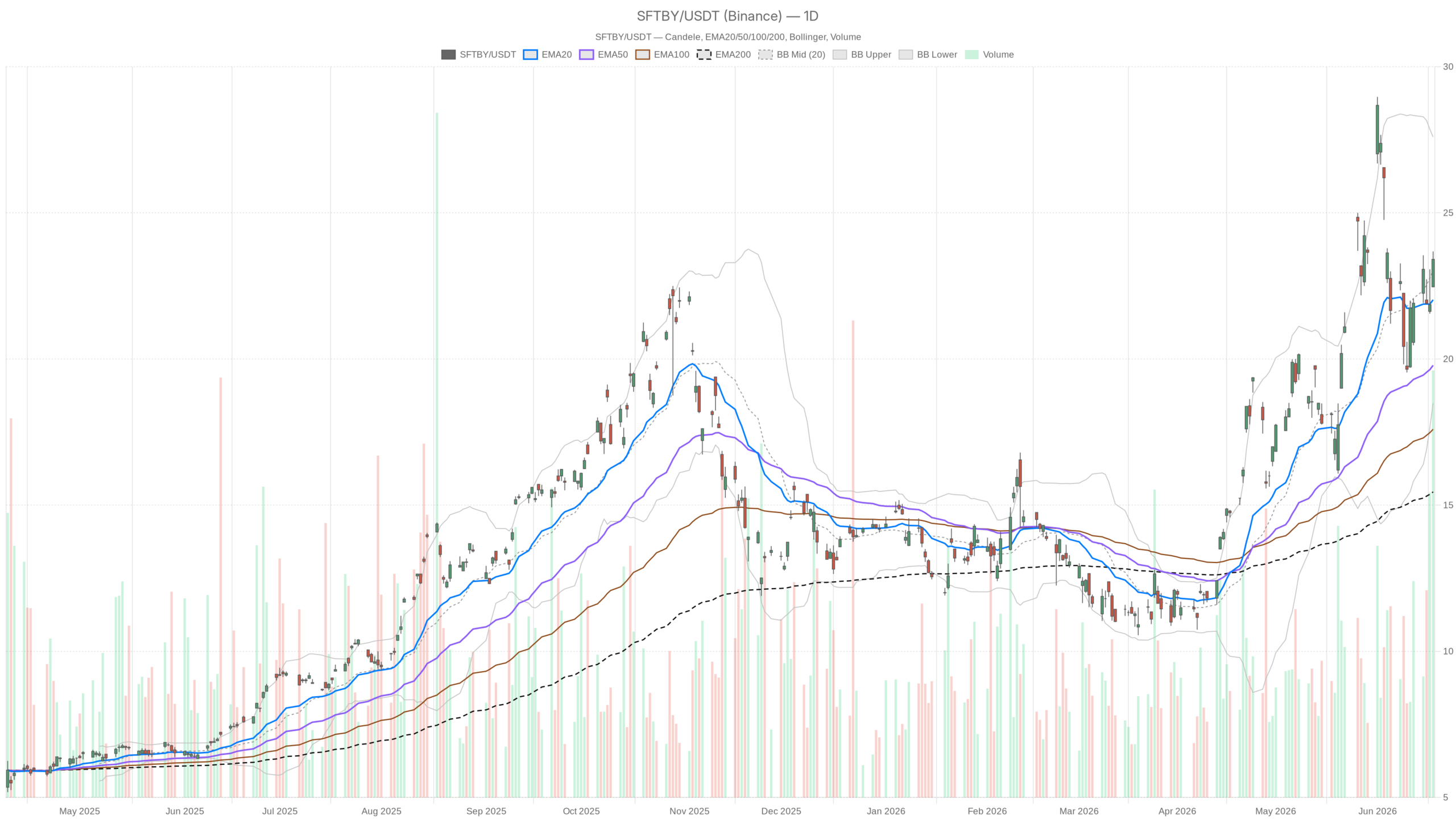 SFTBY — daily chart with candlesticks, EMA20/EMA50 and volume.
Key takeaways
- SoftBank Stock trades above the EMA20 at $22.02, EMA50 at $19.78, and EMA200 at $15.45 on the daily chart, confirming a fully bullish trend structure across all key anchors.
- Daily RSI at 55.61 leaves room for further upside, while the mildly negative MACD histogram signals softening short-term momentum without threatening the broader trend.
- The daily ATR of $2.25 reflects elevated volatility, with Bollinger Bands framing a wide range between $18.49 and $27.60.
- Key support sits at the $22.69 daily S1 pivot and the EMA20 at $22.02; a break below either would shift the short-term tone.
- A clean break above the $23.91 daily R1 pivot opens the path toward the upper Bollinger Band at $27.60 as a medium-term target.
SoftBank Stock Daily Structure: Bullish Alignment With Cooling Momentum
SoftBank Stock maintains a fully bullish trend structure on the daily chart. Price sits well above all three key exponential moving averages, confirming consistent buying across multiple timeframes.
Notably, the EMA stack reads cleanly bullish — EMA20 at $22.02, EMA50 at $19.78, and EMA200 at $15.45. SFTBY closed at $23.41, comfortably clearing every significant trend anchor. This configuration signals a market that has been consistently bid, with no structural reason to argue against the trend.
However, daily momentum tells a more nuanced story. The RSI sits at 55.61 — healthy and not extended, leaving room for further upside. At the same time, the MACD histogram is mildly negative at -0.31. The MACD line at 0.79 sits just below the signal line at 1.10. This is not a reversal signal. It simply indicates the recent impulse leg is losing short-term energy.
Volatility and Pivot Levels Frame the Trading Range
Meanwhile, the daily ATR of $2.25 reflects a stock that moves meaningfully on a session-by-session basis. Bollinger Bands are notably wide — upper at $27.60, lower at $18.49 — confirming substantial recent price swings. Current price near $23.41 sits just above the midline at $23.04. The stock is not overextended within the band structure. Daily pivot support at $22.69 and resistance at $23.91 frame the near-term trading range cleanly.
Short-Term Timeframes Confirm the Bullish Bias
Meanwhile, both the 1-hour and 15-minute charts align bullishly with the daily structure. The shorter timeframes reinforce the case for continued upside rather than complicating it.
On the 1H chart, price holds above the EMA20 at $22.77, EMA50 at $22.46, and EMA200 at $21.48 — another clean bullish stack. The hourly RSI at 61.12 sits in constructive territory: elevated enough to confirm buying interest, yet not stretched into overbought levels. The 1H MACD histogram is a modest positive at 0.08, giving short-term momentum a slight bullish tilt. Overall, the hourly picture aligns well with the daily bias.
15-Minute Chart Shows Signs of Near-Term Pause
Still, the 15-minute picture reveals subtle hints of a pause emerging. The MACD histogram is essentially flat at -0.01, and the RSI at 56.94 reads neutral-to-slightly-bullish. Price hugs the upper Bollinger Band — $23.67 upper, $22.92 lower — suggesting intraday momentum remains positive but is nearing short-term resistance. The 15m pivot at $23.45 aligns tightly with current price. This zone naturally invites brief consolidation before the next directional move.
Fundamental Catalysts Behind SoftBank Stock’s Strength
SoftBank Stock’s technical strength is backed by a powerful fundamental narrative centered on dual AI exposure and improving geopolitical sentiment.
Earlier in June, SFTBY surged approximately 12% as Asian tech stocks rallied on news of a U.S.-Iran peace deal reopening the Strait of Hormuz. Geopolitical risk relief of that magnitude tends to have a lasting positive effect on sentiment. This is especially true for high-beta tech conglomerates like SoftBank.
Meanwhile, investor attention is increasingly focused on SoftBank’s dual AI exposure. The company holds a major stake in Arm Holdings and maintains deep ties to OpenAI ahead of a widely anticipated IPO. Its Net Asset Value reportedly hit a record ¥40.1 trillion. Notably, some analysts are framing any near-term pullback as a buying opportunity rather than a cause for concern.
SoftBank Stock Scenarios: Continuation vs. Momentum Fatigue
The base case remains a controlled grind higher. However, momentum fatigue on the daily MACD introduces a credible pullback risk that traders should monitor.
Bullish Case: Grind Toward $27.60
In the bullish scenario, SFTBY continues its measured advance. A clean break and hold above the $23.91 daily R1 pivot would open the door toward the upper Bollinger Band at $27.60 as a medium-term target. Positive news flow around the OpenAI IPO timeline or Arm’s valuation could act as a near-term catalyst. Sustained 1H RSI above 60 and a returning positive MACD histogram on the daily would confirm continuation.
Bearish Case: Pullback Risk on Momentum Fatigue
In contrast, the bearish case rests primarily on momentum fatigue. If the daily MACD histogram fails to recover and crosses deeper into negative territory, that would signal the current consolidation is evolving into a meaningful pullback. A break below the daily S1 pivot at $22.69 — and particularly below the EMA20 at $22.02 — would shift the short-term tone and invite a retest of lower support. Broader macro headwinds, renewed geopolitical tension, or disappointment around AI monetization timelines could all accelerate such a move.
Positioning Strategy and Key Levels for SFTBY
Overall, the trend is firmly bullish across all timeframes. The main risk is not direction — it is timing. Momentum is cooling slightly at the daily level, and short-term resistance clusters just above current price. Positioning here requires patience.
The trend is a clear tailwind, but traders chasing the recent breakout may find the next few sessions choppy. Those with a longer view will likely be comfortable holding through the noise. Volatility remains elevated. With a daily ATR above $2, any given session can move the needle significantly in either direction.
FAQ
Is SoftBank Stock still in a bullish trend?
Yes. SoftBank Stock closed at $23.41 on June 18, well above the EMA20 ($22.02), EMA50 ($19.78), and EMA200 ($15.45) on the daily chart. All three major timeframes — daily, 1-hour, and 15-minute — show a clean bullish EMA alignment with no structural reason to turn bearish.
What are the key support levels for SFTBY?
The first key support is the daily S1 pivot at $22.69. Below that, the EMA20 at $22.02 serves as the critical trend-defining level. A break beneath the EMA20 would shift the short-term tone and potentially invite a retest of lower support zones.
What could trigger a pullback in SoftBank Stock?
A bearish move would most likely be triggered by momentum fatigue materializing into a deeper MACD decline on the daily chart. Additional catalysts include broader macro headwinds, renewed geopolitical tension, or disappointment around AI monetization timelines.
What is the medium-term upside target for SoftBank Stock?
A clean break above the $23.91 daily R1 pivot opens the path toward the upper Bollinger Band at $27.60 as a medium-term target. Positive developments around the OpenAI IPO or Arm Holdings valuation could accelerate this move.
Disclaimer: This article is for informational purposes only and does not constitute financial advice, an investment recommendation, or a solicitation to buy or sell any financial instrument or cryptocurrency. The analysis provided is not indicative of future results. Investing in crypto assets and financial markets carries a high risk of capital loss. Always do your own research (DYOR) and consult a qualified financial advisor before making any decision.
Article produced with the assistance of artificial intelligence and reviewed by the editorial team.




 English (US) ·