
 2 months ago
61
2 months ago
61
- Sui introduced gasless stablecoin transfers, allowing users to send supported stablecoins without paying transaction fees directly.
- The network processed more transactions than Ethereum during Q2 2026, signaling strong on-chain activity growth.
- Analysts believe Sui’s stablecoin strategy could strengthen its push toward institutional finance and global payments infrastructure.
When a blockchain starts aggressively leaning into stablecoins, it usually signals something much bigger than just another technical upgrade. More often than not, it means the network is trying to position itself directly inside the future of global payments — and right now, that’s exactly what Sui appears to be doing.
The logic behind it is actually pretty simple. Payments represent a multi-trillion-dollar global industry, and Layer-1 blockchains increasingly want a piece of that infrastructure. Stablecoins are becoming the settlement layer powering much of this transition, which is why so many crypto ecosystems are suddenly racing toward stablecoin adoption, liquidity, and payment efficiency all at once.
Sui’s latest move fits perfectly into that trend.
The network recently rolled out gasless stablecoin transfers through a protocol-level upgrade that allows users and businesses to send supported stablecoins peer-to-peer without paying gas fees directly or even holding separate SUI balances for transactions. In practical terms, sending stablecoins on Sui now feels almost frictionless — basically near-zero cost for supported transfers.
And honestly, that changes the onboarding experience quite a bit.
Sui Is Quietly Building a Serious Stablecoin Ecosystem
The rollout already supports several stablecoins including USDsui, SuiUSDe, USDC, and USDY. From a technical perspective, institutional users can now move across these assets without dealing with the extra complications typically tied to blockchain gas mechanics.
That matters more than people sometimes realize.
One of crypto’s biggest usability problems has always been forcing users to manage native gas tokens separately just to complete simple payments. Sui seems to be removing that barrier directly at the protocol level instead of relying on complicated workarounds layered on top.
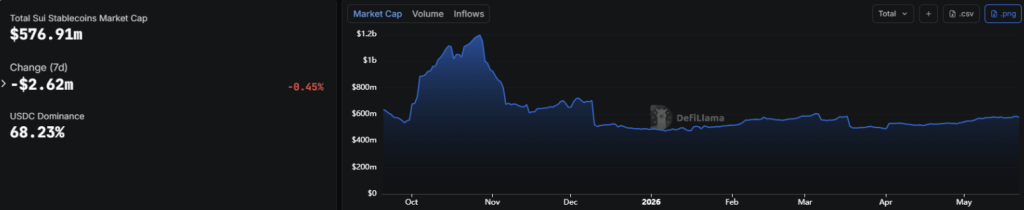
USDC remains especially important inside this ecosystem. More than 68% of Sui’s total stablecoin supply currently sits in USDC, making it the dominant settlement asset across the network. And the stablecoin ecosystem itself has continued growing steadily. During Q2 alone, Sui’s stablecoin market expanded by roughly 9%, bringing in around $50 million in net inflows.
Interestingly, that growth also happened alongside a 25%+ rally in the SUI token itself.
Naturally, traders are beginning to ask whether Sui’s improving technical setup is now being matched by genuinely stronger on-chain fundamentals underneath the surface — and whether these stablecoin developments are gradually pushing Sui closer toward becoming what some are calling “Wall Street ready.”
SUI’s Transaction Growth Is Starting to Stand Out
The bigger story may actually be happening on-chain.
Sui’s stablecoin strategy revolves heavily around becoming infrastructure for global payments, so one of the most important things to monitor is transaction activity itself. And based on recent data, the network is already processing surprisingly large volumes compared to several bigger blockchain ecosystems.
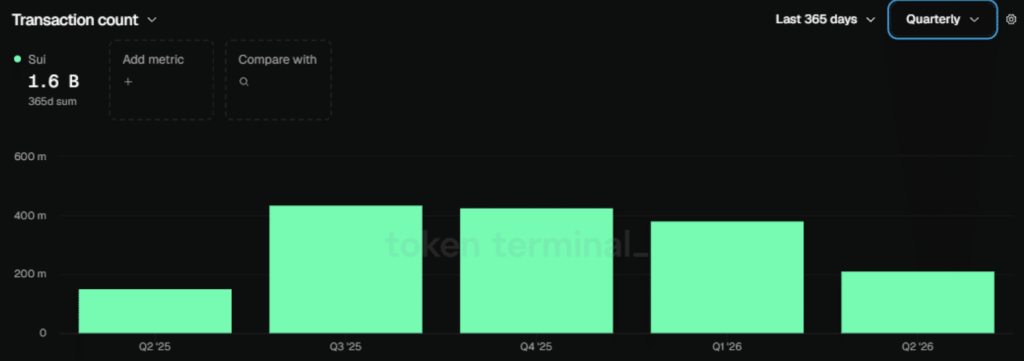
Since Q2 2025, SUI has reportedly processed around 1.6 billion transactions. Even though quarter-over-quarter activity cooled slightly recently, the network still handled more transactions than Ethereum during Q2 2026. SUI processed roughly 215 million transactions during the quarter compared to Ethereum’s 117 million.
That’s a pretty significant gap.
It suggests Sui’s technical advantages aren’t just theoretical anymore. Real users are actively utilizing the network at scale, which strengthens the argument that the ecosystem is building genuine on-chain momentum rather than simply riding speculative hype cycles.
And when you combine strong transaction growth with free stablecoin transfers, the strategy starts looking increasingly deliberate.
Free Stablecoin Transfers Could Accelerate Adoption Further
Making stablecoin transactions effectively free on a high-throughput network changes the economics of usage pretty dramatically. Lower friction tends to attract more payments activity, more liquidity movement, and potentially more institutional experimentation around blockchain settlement systems.
If transaction growth continues accelerating, SUI could realistically push toward 400 million-plus transaction quarters in the future. That possibility is exactly why some analysts believe Sui may be positioning itself ahead of a broader industry trend where stablecoin infrastructure becomes one of the most important competitive battlegrounds in crypto.
At the same time, Sui is already outperforming many altcoins across both technical and on-chain activity metrics. The stablecoin model may simply widen that advantage further if adoption continues expanding.
Is Sui Positioning Itself for Institutional Finance?
The larger question now is whether this becomes the beginning of a much bigger institutional push.
Stablecoins increasingly sit at the center of modern crypto finance because they connect blockchain infrastructure directly to real-world economic activity. Networks that can make stablecoin movement fast, cheap, and scalable naturally become more attractive for payments, settlement, tokenized assets, and eventually larger financial applications.
Sui seems very aware of that shift.
Whether the ecosystem ultimately succeeds in becoming a dominant institutional settlement layer remains uncertain, obviously. Competition across Layer-1 networks is still intense, and Ethereum, Solana, and other chains continue aggressively expanding their own stablecoin ecosystems too.
But right now, Sui looks like one of the few networks making stablecoin usability a core protocol priority instead of just another side feature buried inside DeFi narratives.
And the market appears to be noticing.
Disclaimer: BlockNews provides independent reporting on crypto, blockchain, and digital finance. All content is for informational purposes only and does not constitute financial advice. Readers should do their own research before making investment decisions. Some articles may use AI tools to assist in drafting, but every piece is reviewed and edited by our editorial team of experienced crypto writers and analysts before publication.




 English (US) ·