
 5 months ago
82
5 months ago
82
- New bill targets China dominance in Bitcoin mining hardware supply
- Introduces “Mined in America” certification for domestic operations
- Establishes a Strategic Bitcoin Reserve under U.S. Treasury
The U.S. is starting to treat Bitcoin less like an experiment and more like infrastructure. A new bill, the “Mined in America Act,” introduced by Senators Bill Cassidy and Cynthia Lummis, is aiming to bring crypto mining back onto domestic soil while also locking in a national Bitcoin strategy. It’s not just about mining, it’s about control.
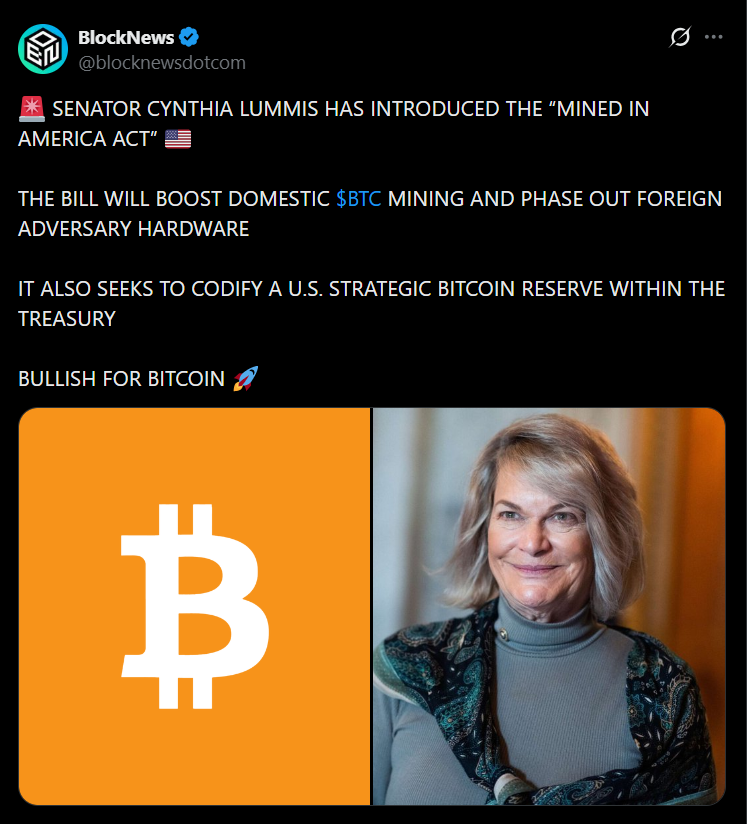
Right now, the numbers are a bit uncomfortable. The U.S. accounts for roughly 38% of global Bitcoin hash rate, but about 97% of the hardware powering that mining comes from China. That imbalance is exactly what lawmakers are trying to address, and they’re framing it as a national security issue, not just an economic one.
A Push to Rebuild the Mining Supply Chain
At the center of the bill is a new certification system. The Department of Commerce would create a voluntary “Mined in America” program, allowing mining operations to be officially recognized if they meet certain standards. One of the key requirements, though, is moving away from hardware tied to foreign adversaries.
That’s a big shift. It’s not forcing immediate change, but it’s creating incentives to gradually rebuild the supply chain domestically. Over time, that could reshape where and how mining infrastructure is produced.
No New Spending, But Strategic Integration
Interestingly, the bill doesn’t introduce major new federal spending. Instead, it plugs certified mining projects into existing programs, particularly those tied to energy and rural development. That suggests a more layered approach, using infrastructure that’s already in place rather than building from scratch.
It also brings in institutions like NIST to support the development of more energy-efficient mining hardware in the U.S. That’s not just about independence, it’s about competitiveness over time.

The Strategic Bitcoin Reserve Becomes Official
One of the more notable pieces of the bill is the formal creation of a Strategic Bitcoin Reserve within the Treasury. This would codify a previous executive order and turn it into a more permanent part of U.S. policy.
That move alone signals a shift in how Bitcoin is being viewed. Not just as an asset class, but as something with strategic importance, similar in concept, at least loosely, to other national reserves.
Mining, Energy, and Policy Start to Converge
What’s happening here feels bigger than a single bill. Mining, energy infrastructure, and national policy are starting to intersect more directly. The idea of building a “virtuous cycle,” domestic manufacturing, energy development, and Bitcoin accumulation, suggests a more coordinated approach.
And once those pieces start aligning, it changes how crypto fits into the broader economy. It’s less isolated, more integrated.
A Shift Toward Strategic Control
If this bill moves forward, it would mark a clear change in direction. The U.S. wouldn’t just be participating in Bitcoin mining, it would be actively shaping how and where it happens.
That’s the bigger takeaway. This isn’t just about bringing miners home. It’s about reducing dependency, building infrastructure, and positioning Bitcoin within a national strategy that’s still evolving.
Disclaimer: BlockNews provides independent reporting on crypto, blockchain, and digital finance. All content is for informational purposes only and does not constitute financial advice. Readers should do their own research before making investment decisions. Some articles may use AI tools to assist in drafting, but every piece is reviewed and edited by our editorial team of experienced crypto writers and analysts before publication.








 English (US) ·