
 2 months ago
39
2 months ago
39
- XRP and XLM are holding key support levels amid rising geopolitical tension
- Short-term downside risk remains if markets shift further into risk-off mode
- Long-term utility as payment networks could drive faster recovery if adoption increases
Things feel a bit… uneasy again. The Iran ceasefire expired on April 22, and so far, nothing has replaced it. No extension, no clear path forward. Naturally, markets are reacting—oil creeping higher, gold pushing close to $4,800, and risk assets… well, hesitating.
Crypto isn’t immune to that mood either. XRP is hovering around $1.42, slightly down, while XLM sits near $0.17, also drifting lower. Both are holding above key moving averages, but you can tell—this isn’t a confident market. It’s waiting.
Tension Builds Around a Critical Global Flashpoint
The bigger concern sits around the Strait of Hormuz. It’s one of those places most people don’t think about… until something happens. Roughly 20% of global oil flows through it, so even a minor disruption could ripple across everything.
Right now, the US and Israel are positioning assets in the region, while Iran hasn’t committed to extending the ceasefire. Analysts are watching two main possibilities—either a direct strike or indirect retaliation through regional allies.
Markets have already started pricing in risk. Oil up. Gold rising. Dollar strengthening. Crypto? Pulling back a bit, not crashing, but cautious.
XRP and XLM Sit in a Strange Position
Here’s where it gets interesting. XRP and XLM aren’t just speculative assets—they’re payment networks. And in times of geopolitical stress, payment infrastructure suddenly becomes… important.
That creates a bit of a paradox.
If tensions escalate, both tokens could drop initially—panic selling tends to hit everything. But longer term? Their utility might actually increase, especially if traditional systems face friction or restrictions.
So you’ve got short-term weakness… and potential long-term strength. Not the easiest setup to trade.
XRP Holds Support While Watching for a Catalyst
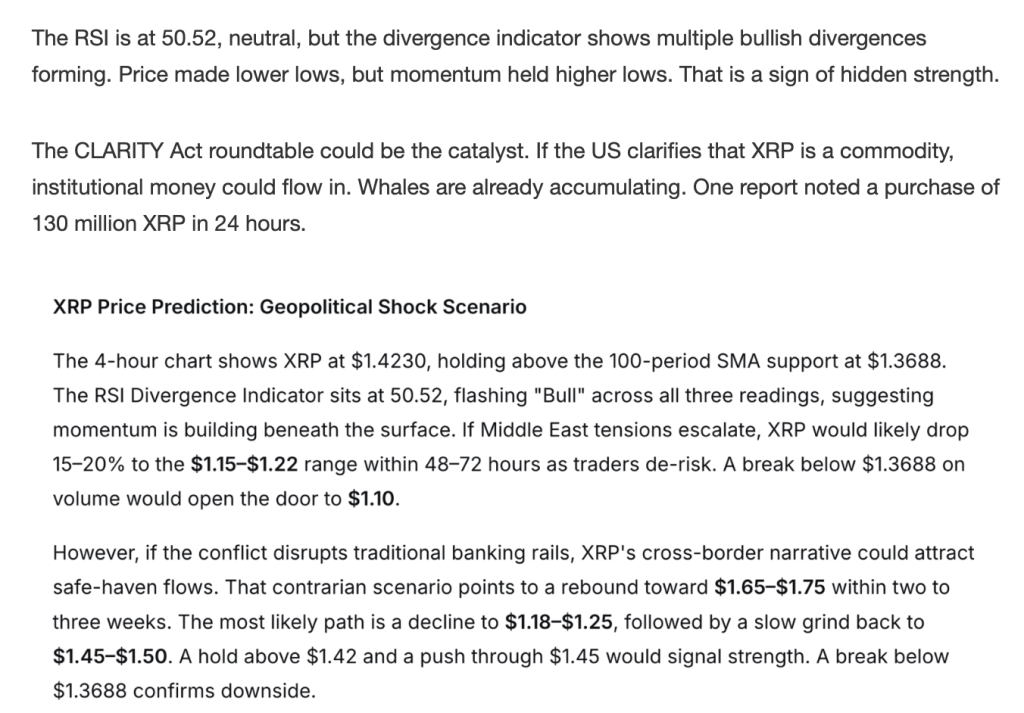
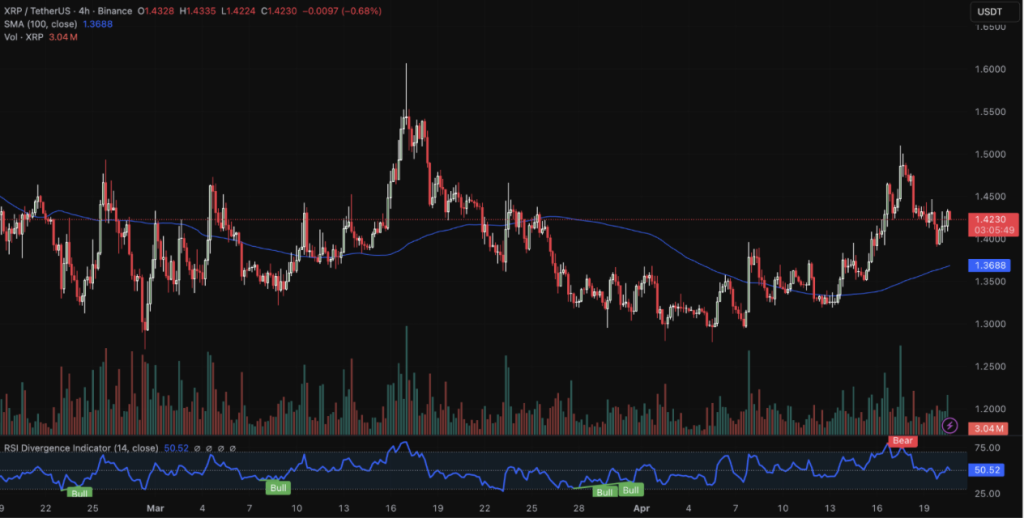
Right now, XRP is holding above its 100 SMA near $1.36. Resistance sits just above—$1.45, then $1.50, maybe $1.55 if momentum builds. Support, meanwhile, is tight around $1.40 and slightly lower.
Indicators are… neutral, mostly. RSI sits around 50, but there’s a hint of bullish divergence forming. Price made lower lows recently, but momentum didn’t follow. That usually signals some hidden strength.
There’s also a regulatory angle in play. The CLARITY Act discussions could shift how XRP is classified in the US. If that lands favorably, institutional flows could pick up quickly.
Whales seem to be positioning already—large accumulation has been spotted, including one reported buy of over 130 million XRP in a day. That’s not small.
Still, if geopolitical tension spikes, XRP could dip toward $1.35… maybe even $1.30 briefly. But if its payment utility becomes relevant in a fractured system, a rebound toward $1.60 or higher isn’t out of the question.
XLM Mirrors the Setup, With Its Own Catalysts
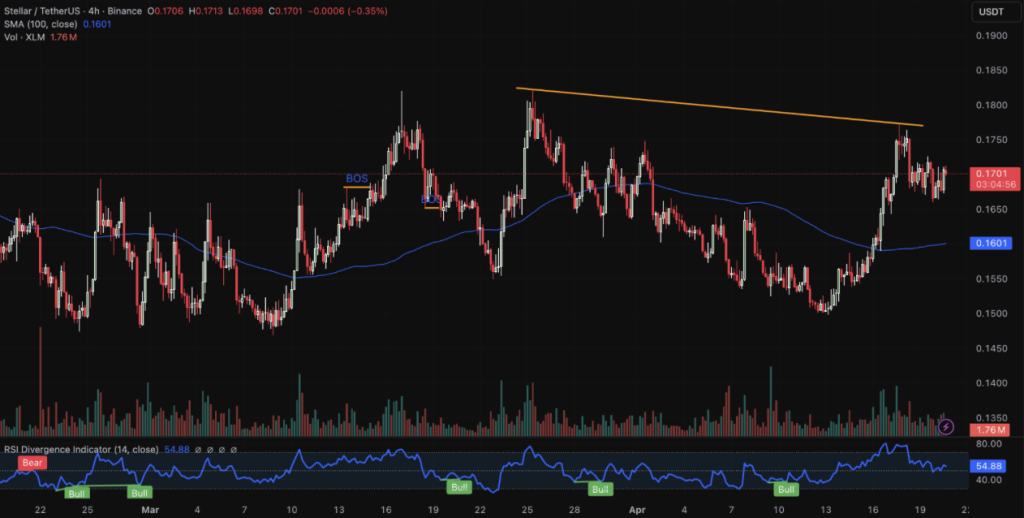
Stellar is in a similar spot. Price is holding above its own support near $0.16, with resistance stacked around $0.175 to $0.185. RSI leans slightly bullish, but not decisively.
Like XRP, XLM is showing signs of bullish divergence underneath the surface. Nothing explosive, just… quietly building.
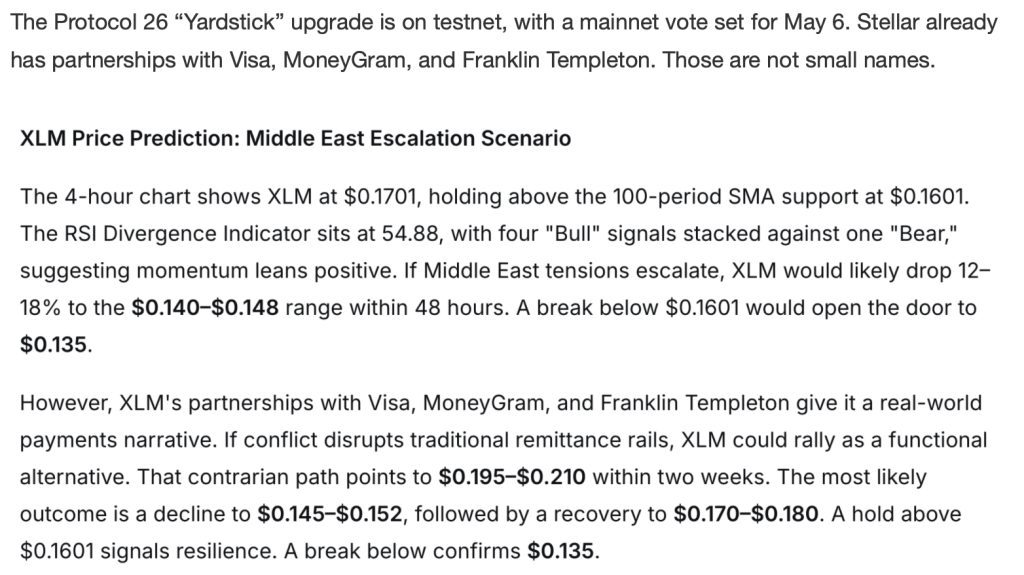
There’s also a key upgrade coming—Protocol 26, currently on testnet, with a vote scheduled soon. Add to that partnerships with names like Visa and MoneyGram, and you start to see the bigger picture forming.
If traditional payment rails face disruption, Stellar could see increased activity. But again, the short-term reaction might still be downside first—perhaps toward $0.16 or even slightly below before stabilizing.
A Market Waiting for Direction
At this point, both XRP and XLM are sitting at critical levels. Technically stable, but not breaking out. Fundamentally interesting, but tied to broader uncertainty.
If things escalate in the Middle East, a 5–10% drop wouldn’t be surprising. That’s just how risk-off environments behave. But if payment infrastructure becomes a focal point, these networks could recover faster than most.
So everything comes down to what happens next. Headlines will likely drive the first move. Utility might drive what follows.
For now… it’s a waiting game.
Disclaimer: BlockNews provides independent reporting on crypto, blockchain, and digital finance. All content is for informational purposes only and does not constitute financial advice. Readers should do their own research before making investment decisions. Some articles may use AI tools to assist in drafting, but every piece is reviewed and edited by our editorial team of experienced crypto writers and analysts before publication.







 English (US) ·