
 2 months ago
47
2 months ago
47
- Debate continues over whether banks would adopt XRP given Ripple’s large holdings
- David Schwartz argues institutions prioritize efficiency, not who benefits indirectly
- Regulatory clarity may play a key role in shaping future institutional adoption
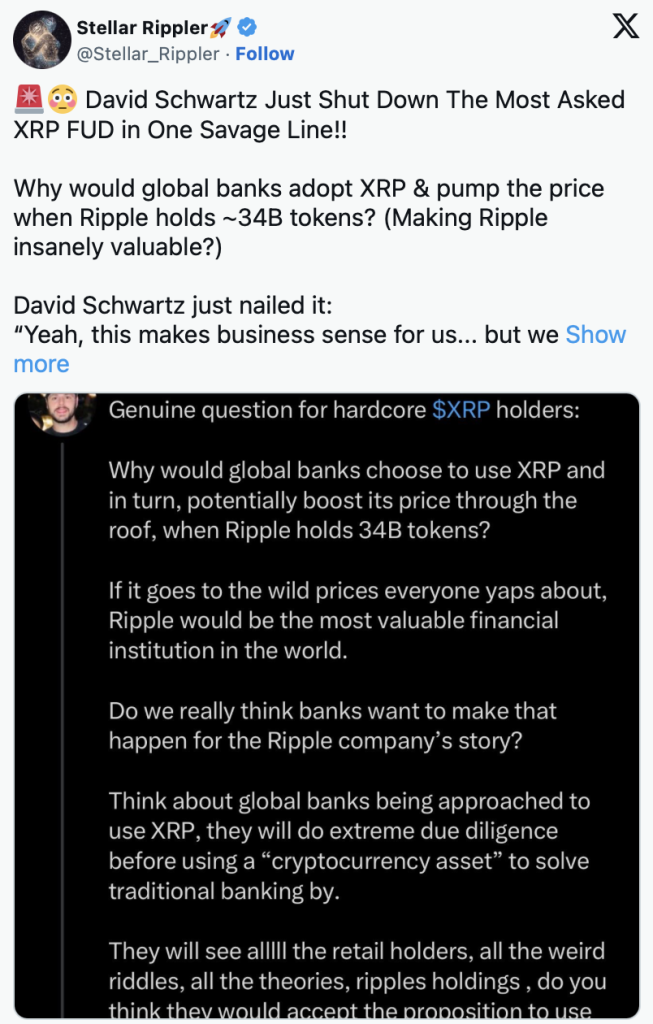
A recent post on X by crypto commentator Stellar Rippler has brought back a debate that never really disappears. It centers on a simple but uncomfortable question — would banks actually adopt XRP if doing so ends up boosting Ripple’s own holdings significantly?
The post included a reply from David Schwartz, and that alone was enough to spark fresh discussion. It’s one of those topics where opinions tend to split quickly, mostly because it sits right between economics and perception.
The Concern Around Ripple’s Holdings
At the core of the debate is Ripple’s large XRP reserve, estimated at around 34 billion tokens. Critics argue that if banks adopt XRP at scale, they could indirectly increase the value of Ripple’s holdings… and that might not sit well with institutions.
The logic goes like this: why would banks contribute to making another company more valuable, even if the underlying technology works? It’s not just about efficiency, but also about incentives and optics — especially after due diligence.
Some even take it further, suggesting that widespread XRP adoption could elevate Ripple into one of the most powerful financial entities globally. And for traditional institutions, that possibility alone might raise questions.
Schwartz Pushes Back, Directly
David Schwartz didn’t overcomplicate his response. In fact, it was pretty blunt — and maybe that’s why it stood out.
He essentially dismissed the idea that banks would reject something profitable just because another company benefits too. The quote shared in the post captured it well, pointing out how unrealistic that kind of decision-making would be in practice.
From that perspective, institutions don’t operate based on who else wins. They focus on whether a system improves their own operations — faster settlements, lower costs, better efficiency. If those boxes are checked, the rest becomes secondary.

Utility Versus Perception in Financial Decisions
Stellar Rippler’s take leans heavily in that direction. The argument is that banks already work with third-party providers all the time — tech vendors, infrastructure partners, payment networks — and those relationships always involve shared profit.
So why would XRP be treated differently?
If the asset delivers measurable benefits in cross-border payments, then, in theory, institutions would adopt it regardless of Ripple’s position. It’s less about ideology and more about practicality… at least that’s the assumption.
Regulation Still Lingers in the Background
The discussion didn’t stop at incentives, though. The post also touched on regulatory factors, suggesting that past hesitation from banks may have been influenced more by policy than by economics.
There’s mention of regulatory pressure during the Biden administration, along with claims that agencies like the SEC created uncertainty around XRP’s status. Whether fully accurate or not, that narrative has been circulating in the crypto space for a while.
Interestingly, the idea of clearer regulation — like the proposed Clarity Act — is framed as a potential turning point. If uncertainty is removed, institutions might evaluate XRP purely on utility, without external concerns shaping their decisions.
Incentives Still Lead the Conversation
At the end of it all, the debate circles back to one main idea — incentives. Financial institutions, more often than not, follow efficiency and profitability.
The question isn’t really whether Ripple benefits. It’s whether XRP makes sense for banks to use.
And if it does… then the rest might not matter as much as people think.
Disclaimer: BlockNews provides independent reporting on crypto, blockchain, and digital finance. All content is for informational purposes only and does not constitute financial advice. Readers should do their own research before making investment decisions. Some articles may use AI tools to assist in drafting, but every piece is reviewed and edited by our editorial team of experienced crypto writers and analysts before publication.









 English (US) ·