
 6 months ago
132
6 months ago
132
- Rising tensions around the Strait of Hormuz have pushed oil prices above $100, increasing inflation concerns.
- Bitcoin remains near $71,500 but is increasingly reacting to broader macroeconomic conditions.
- A liquidity squeeze triggered by rising energy costs could force leveraged derivatives positions to unwind.
Tensions surrounding the Strait of Hormuz are beginning to echo across global financial markets, and energy traders are already reacting. Oil prices have pushed past the $100 per barrel mark, a level that tends to trigger wider concern about supply disruptions and inflationary pressure. Whenever energy costs jump like this, it rarely stays isolated to oil markets alone.
Higher energy prices typically ripple outward, raising inflation expectations and tightening financial conditions across the board. As liquidity becomes a little more scarce, the U.S. dollar often strengthens while risk assets start to feel the pressure. In this environment, Bitcoin’s behavior has started to look increasingly tied to broader macro forces rather than purely crypto-driven narratives.
Bitcoin itself has been hovering near the $71,500 region recently, showing relative stability on the surface. But underneath that calm price movement sits a much more fragile structure, especially in derivatives markets where leverage has expanded rapidly. When too many traders pile into futures positions, even a small liquidity shock can force rapid unwinds.
Oil Shock Could Tighten Liquidity and Spill Into Crypto Markets
The Strait of Hormuz plays a critical role in global energy logistics, carrying roughly 20 million barrels of oil through its shipping corridor every day. Any disruption to that flow—even temporary—can quickly push energy markets into volatility.
If oil continues climbing, inflation expectations could accelerate again. That scenario would make central banks more cautious about cutting interest rates, delaying monetary easing and tightening liquidity conditions across financial markets.
Historically, environments like this tend to spill over into risk assets, and Bitcoin isn’t completely immune. Even though it often trades independently during crypto-specific cycles, macro shocks can still influence its short-term behavior.
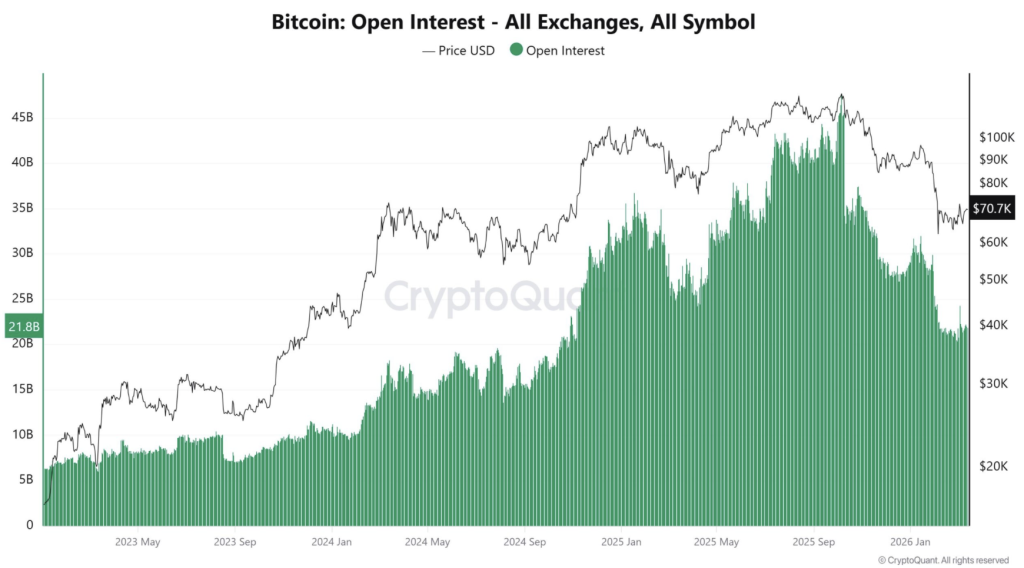
Recent derivatives data already hint that the market is cooling slightly. Open Interest across Bitcoin futures once exceeded $40 billion during peak speculation, but it has since dropped to roughly $21.8 billion. That decline suggests traders have already begun reducing leverage after earlier aggressive positioning.
Funding rates have also flattened out, hovering near neutral levels and occasionally dipping into negative territory. That kind of shift usually reflects caution creeping back into the market.
Bitcoin Holds Steady but Remains Liquidity-Sensitive
Despite the geopolitical tension, Bitcoin has so far shown a relatively stable response. The asset briefly slipped when headlines around the Iran conflict intensified, yet it quickly rebounded and stabilized near the $70,000 level.
Nic Puckrin, co-founder of Coin Bureau, noted that Bitcoin’s reaction has been surprisingly calm compared to earlier geopolitical shocks.
According to Puckrin, Bitcoin initially dipped on the news but recovered quickly, settling into a relatively tight trading range around $70,000. That kind of resilience contrasts with how the market behaved during past crises.
Back in 2022, when Russia’s invasion of Ukraine pushed oil prices toward $120 per barrel, Bitcoin eventually weakened alongside other risk assets. The 2020 pandemic shock produced an even sharper reaction, sending BTC down nearly 40% as global markets scrambled for liquidity.
Macro Forces May Now Drive Bitcoin’s Next Move
The current environment presents a delicate balance. On one hand, Bitcoin has matured significantly as an asset class, attracting institutional attention and broader adoption. On the other, its derivatives markets remain deeply intertwined with global liquidity conditions.
If oil-driven inflation continues to build, central banks may maintain tighter policy for longer than markets currently expect. That would reduce liquidity across financial systems and potentially trigger pressure on leveraged positions.
And that’s where the risk sits. Bitcoin might not move sharply because of crypto-specific news, but rather due to macro shocks forcing leveraged traders to unwind positions across futures markets.
In short, Bitcoin’s next big move might depend less on blockchain headlines and more on global macro events—particularly those that tighten liquidity when derivatives positioning remains heavily exposed.
Disclaimer: BlockNews provides independent reporting on crypto, blockchain, and digital finance. All content is for informational purposes only and does not constitute financial advice. Readers should do their own research before making investment decisions. Some articles may use AI tools to assist in drafting, but every piece is reviewed and edited by our editorial team of experienced crypto writers and analysts before publication.






 English (US) ·