
 4 months ago
76
4 months ago
76
- Bitcoin leverage continues rising as Open Interest nears $57 billion and Binance ELR approaches extreme levels.
- Weak ETF inflows and rising realized profits are increasing pressure beneath the $82,000 resistance zone.
- Long-term holders remain steady, helping stabilize Bitcoin despite growing short-term volatility concerns.
Bitcoin’s recent consolidation phase has started showing signs of deeper instability, especially as leverage across the Futures market keeps rising while institutional participation weakens in the background. The broader structure around BTC has remained reactive rather than fully bullish, with traders aggressively positioning around resistance instead of strong spot-driven accumulation. Earlier rejection attempts near the $82,000 level only added fuel to that environment, pushing speculative activity even higher as volatility tightened across the market.
At the time of writing, Bitcoin Open Interest hovered near a massive $57 billion across major exchanges, highlighting just how crowded the derivatives trade has become. At the same time, Binance’s Estimated Leverage Ratio climbed toward 14.9%, a level many analysts consider extremely elevated. In healthier bull markets, rallies usually lean heavily on spot buying and organic demand. Right now though, Bitcoin’s movement seems increasingly dependent on leveraged positions, and that creates a much more fragile setup whenever momentum suddenly shifts.
Weak ETF Demand Adds More Stress to Market Structure
Institutional sentiment has also softened recently after spot Bitcoin ETFs recorded roughly $290 million in outflows, adding another layer of concern beneath the surface. While retail traders continue chasing short-term moves through derivatives markets, larger institutional players appear far less aggressive than they were earlier in the cycle. That imbalance matters because spot-driven inflows generally provide stronger price support compared to leverage-heavy rallies that can unwind fast.
Still, not everything looks completely broken yet. Analysts believe a cooling-off period in leverage conditions, combined with renewed ETF demand, could stabilize Bitcoin’s broader structure before liquidation risks intensify further. The market is basically stuck in an awkward phase where traders want upside continuation, but conviction underneath the rally still feels shaky. One sharp move either way could probably shift sentiment very quickly.
Rising Profitability Creates More Selling Pressure
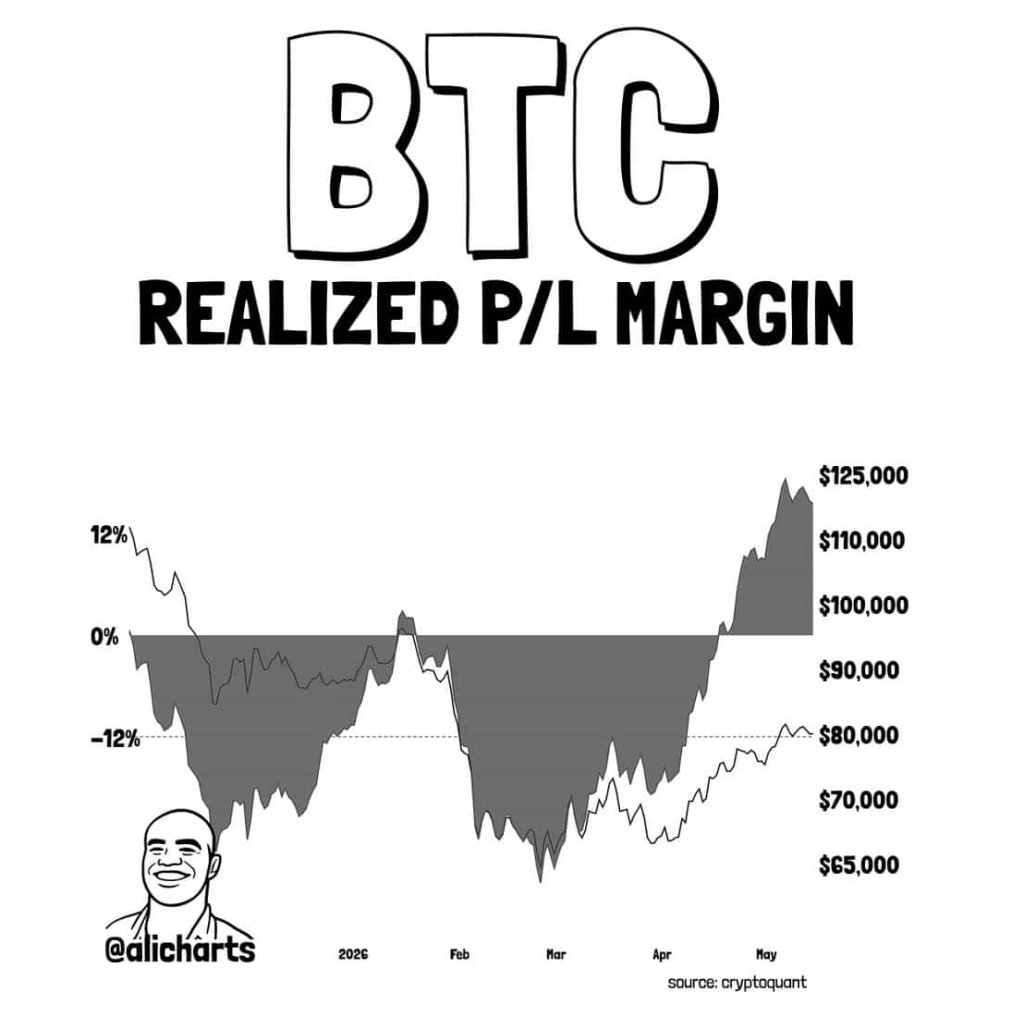
Another challenge developing beneath Bitcoin’s resistance zone is the rapid increase in realized profits. Earlier rebounds from the broader $65,000 area pushed a large share of BTC holders back into profitable territory, naturally encouraging more traders to lock in gains as price approached higher levels. That pressure intensified once average realized profit margins climbed toward 17%, their highest reading since October 2025.
Meanwhile, Bitcoin continues struggling to reclaim the wider $82,000 resistance zone while realized profits surged toward nearly 14,600 BTC, worth around $1.1 billion. That kind of behavior usually signals growing hesitation from market participants. Traders aren’t necessarily panicking, but they are clearly becoming more willing to secure profits while macroeconomic uncertainty remains elevated. Confidence in a clean breakout just hasn’t fully returned yet, honestly.
Despite the rising sell-side activity, stronger spot demand and better liquidity absorption could still help stabilize conditions before downside momentum accelerates. The next few sessions will probably matter more than usual because leverage remains stretched while profit-taking pressure continues building underneath resistance.
Long-Term Holders Continue Supporting Bitcoin’s Foundation
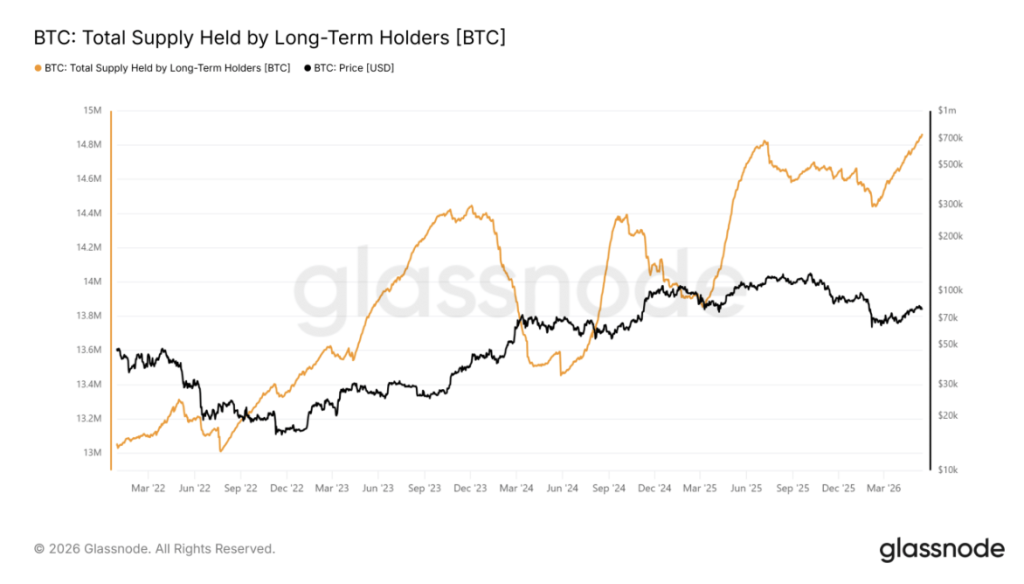
Even with short-term volatility increasing, long-term Bitcoin holders still appear remarkably steady. Wallets holding BTC inactive for more than 155 days now control nearly 14.84 million BTC, according to Glassnode data. That trend suggests stronger hands continue absorbing market swings instead of rushing for exits during periods of uncertainty. It’s actually one of the more important stabilizing factors in the current environment.
Long-Term Holder Net Unrealized Profit/Loss, or NUPL, remained relatively moderate near 0.3 at the time of writing, showing conviction without the kind of euphoric conditions that often appear near major cycle tops. In other words, experienced holders still seem comfortable holding through volatility for now. But if Bitcoin continues failing beneath resistance while leverage pressure grows, even stronger hands could eventually start feeling the strain.
For the moment, Bitcoin’s structure remains balanced somewhere between resilience and fragility. The market still has support underneath it, though the growing dependence on leveraged positioning makes every move feel a little less stable than it probably should.
Disclaimer: BlockNews provides independent reporting on crypto, blockchain, and digital finance. All content is for informational purposes only and does not constitute financial advice. Readers should do their own research before making investment decisions. Some articles may use AI tools to assist in drafting, but every piece is reviewed and edited by our editorial team of experienced crypto writers and analysts before publication.







 English (US) ·