
 6 months ago
101
6 months ago
101
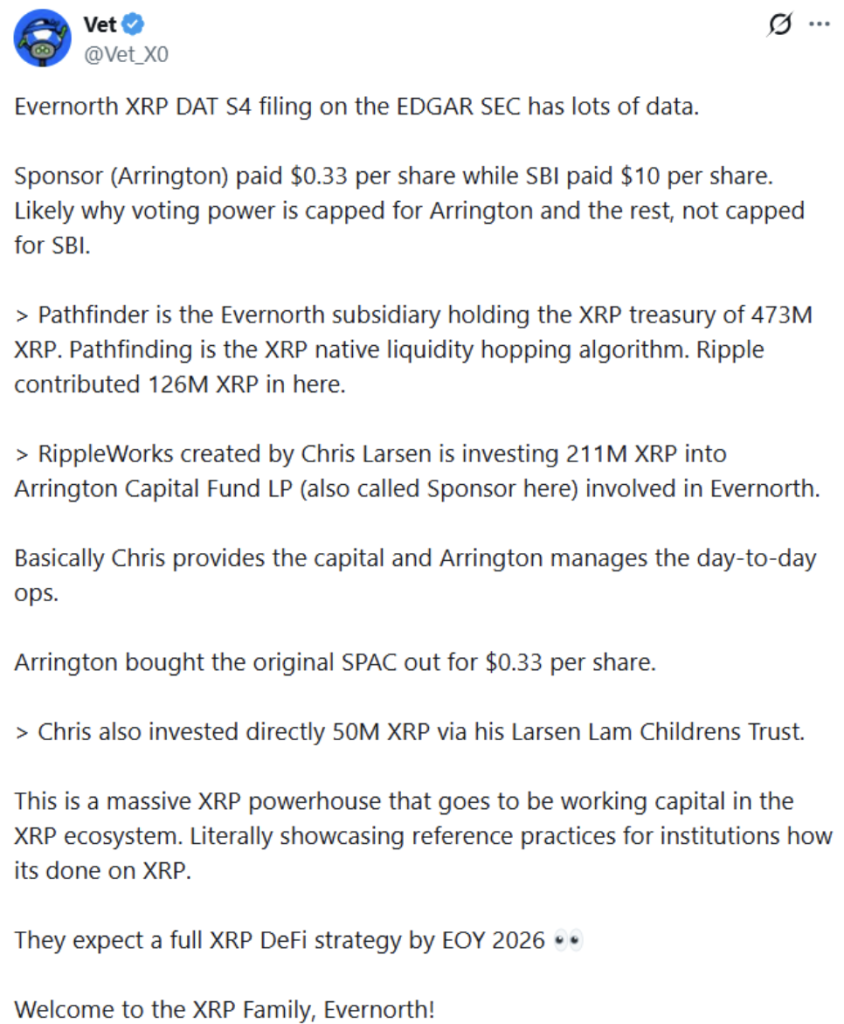
There’s a pretty massive development hiding in plain sight, and honestly, most people probably skimmed right past it. Evernorth Holdings recently filed a Form S-4 with the SEC, and tucked inside all that legal language is what looks like the early framework for a serious XRP treasury strategy. Not just a small allocation either, we’re talking close to 1 billion XRP potentially being mobilized as working capital. It’s one of those things that doesn’t scream headlines at first… but maybe it should.
Breaking Down the XRP Treasury Structure
The details get more interesting the deeper you go. According to insights highlighted by TheCryptoBasic, and backed by Vet, an XRPL dUNL validator with deep ecosystem knowledge, this isn’t just about holding XRP, it’s about using it. Pathfinder, a subsidiary of Evernorth, is managing a chunk of around 473 million XRP, which is already substantial on its own. Then Ripple steps in with another 126 million XRP, and suddenly the scale starts to feel a bit different.
But it doesn’t stop there. RippleWorks, the nonprofit founded by Chris Larsen, is contributing 211 million XRP into Arrington Capital Fund LP. And Larsen himself is adding another 50 million XRP through his family trust. Stack all of that together, and yeah… you’re getting very close to that billion XRP mark, give or take.
The Pricing Gap That Explains Governance Decisions
One part of the filing that really stands out, and maybe raises a few questions, is the pricing difference between investors. Arrington Capital reportedly entered at $0.33 per share, while SBI, a major Japanese financial player, came in at $10 per share. That’s not just a small gap, it’s huge, almost jarring.
Vet’s interpretation here actually makes sense. Because early investors got in at such a low cost, Evernorth appears to be limiting their voting power, while higher-cost participants like SBI aren’t facing those same restrictions. It’s a way to balance control, so cheaper entry doesn’t automatically translate into dominance. Not perfect, but… practical.
XRP Shifts From Passive Asset to Active Capital
What really changes the narrative here is how XRP is being positioned. This isn’t a passive treasury sitting around waiting for price appreciation. The idea, at least based on what’s outlined, is to turn XRP into active working capital, something that moves, earns, circulates.
There’s even mention of a broader XRP DeFi strategy targeted for rollout by 2026. That suggests this capital could eventually flow into liquidity pools, structured products, and maybe other on-chain financial systems. If that actually materializes, it’s a pretty big shift from how XRP has traditionally been used.
Big Players, Long-Term Signals
And then there’s the lineup of participants, which is hard to ignore. Arrington Capital brings crypto-native investment expertise, SBI represents traditional financial muscle, and Chris Larsen… well, he helped build Ripple in the first place. When this mix of players starts aligning capital at this scale, it usually means something more strategic is underway.
Close to a billion XRP being actively deployed, a roadmap stretching into DeFi, and institutional players stepping in, it all points toward infrastructure being built quietly in the background. Whether the market reacts now or later is another question entirely. But developments like this, they tend to surface in price eventually… just not always right away.
Disclaimer: BlockNews provides independent reporting on crypto, blockchain, and digital finance. All content is for informational purposes only and does not constitute financial advice. Readers should do their own research before making investment decisions. Some articles may use AI tools to assist in drafting, but every piece is reviewed and edited by our editorial team of experienced crypto writers and analysts before publication.








 English (US) ·