
 1 hour ago
10
1 hour ago
10
Key Takeaways
- The precious metal is experiencing its most severe quarterly drop in over eleven years, declining approximately 24% since reaching its January zenith.
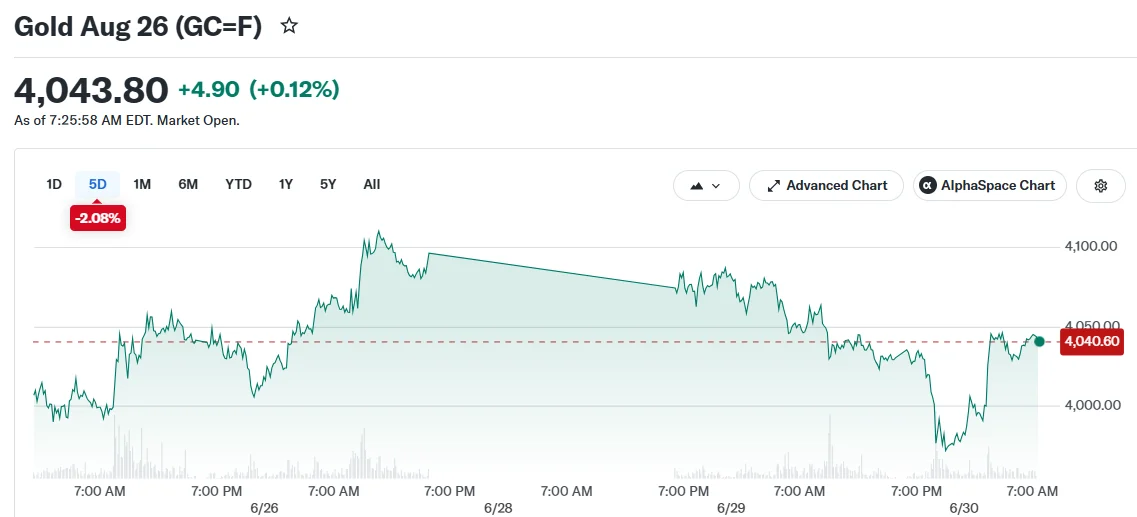
- August Gold Futures hovered around $4,031.70, following a brief drop beneath the $4,000 threshold—the first such occurrence since November 2025.
- The U.S. Dollar Index’s strength, positioned at a 13-month peak, combined with increasing expectations of Federal Reserve rate increases, is fueling the decline.
- For the first time in eight years, options market data reveals traders are purchasing more downside protection than bullish contracts.
- Despite the downturn, Goldman Sachs maintains a forecast of $4,900 per ounce by year-end 2026, supported by anticipated central bank purchasing.
The precious metals market has witnessed a dramatic downturn in recent months, with gold experiencing its most challenging quarter in more than a decade.
Since hitting its late-January pinnacle of approximately $5,589 per ounce, gold has shed roughly 24% of its value. Tuesday’s trading session saw August delivery Gold Futures settling at $4,031.70.
 Gold Aug 26 (GC=F)
Earlier this week, the yellow metal plunged to a seven-month nadir of $3,941. Following this decline, prices managed to stabilize somewhat, climbing back to the $4,028 range during opening hours.
Factors Driving the Precious Metal’s Decline
The primary catalyst behind gold’s retreat is the strengthening U.S. Dollar. Currently, the Dollar Index is hovering near its highest level in 13 months.
When the dollar appreciates, gold becomes costlier for international buyers conducting transactions in alternative currencies. This dynamic suppresses global demand and exerts downward pressure on valuations.
Market participants are increasingly factoring in elevated odds of a Federal Reserve rate adjustment. According to the CME FedWatch Tool, there’s a 63% likelihood of a rate hike during September’s policy meeting.
Unlike yield-generating assets, gold provides no interest income. In rising rate environments, capital typically flows toward instruments offering returns, diminishing gold’s relative appeal.
Inflationary concerns stemming from Middle Eastern geopolitical tensions have compounded market uncertainty. Elevated energy prices have intensified inflation forecasts, reinforcing a more aggressive Fed stance.
Upcoming U.S. employment figures will command significant attention from market watchers. The JOLTS report, ADP Employment Change data, and Nonfarm Payrolls numbers are scheduled for release ahead of the Independence Day holiday weekend.
Robust employment data could propel the dollar to even greater heights, potentially intensifying downward momentum on gold as the third quarter commences.
Options Market Sentiment Reveals Bearish Positioning
A notable transformation has emerged in how market participants are structuring their gold positions. In a development not witnessed since 2016, put option premiums for gold have surpassed call option costs.
This dynamic indicates that a greater number of traders are securing insurance against additional price erosion rather than wagering on a recovery.
Samantha Dart, Goldman Sachs commodity co-head, highlighted this rotation as evidence of evolving market psychology. She noted that interest has migrated from energy-sector bullish positions toward protective gold puts.
Nevertheless, Dart emphasized that she doesn’t anticipate gold’s fundamental long-term trajectory turning bearish. In a June 29 research note, she argued that underlying structural and macroeconomic considerations should bolster higher valuations as the year progresses.
Goldman’s official price target projects gold reaching $4,900 by the conclusion of 2026, representing approximately a 21% appreciation from present levels.
An OMFIF survey encompassing 90 central banks and sovereign investment entities, published June 30, documented a pivot away from dollar-denominated assets. For the first time in the survey’s history, more institutions indicated intentions to decrease dollar reserves than expand them during the coming decade.
A net 30% of respondents expressed plans to augment gold allocations within the next 12 to 24 months.
Gold has also experienced diminished effectiveness as a portfolio hedge against equity market volatility. During earlier 2025 periods, gold demonstrated negative correlation with stocks during turbulent conditions. This relationship has subsequently inverted, with gold now exhibiting increased correlation with equity movements.
From a technical perspective, gold is currently positioned beneath its 50-day, 100-day, and 200-day moving averages, which converge in the $4,440 to $4,660 zone. Market technicians suggest that a sustained breach below the $4,000 threshold could trigger additional selling pressure, with subsequent support zones identified near $3,885 and $3,750.
The post Gold Plummets to Seven-Month Low: Analyzing the Sharpest Decline Since 2013 appeared first on Blockonomi.






 English (US) ·