
 1 hour ago
24
1 hour ago
24
- Ripple has proposed a new lending protocol for the XRP Ledger that would allow institutions to borrow against tokenized assets.
- The protocol separates on-chain infrastructure from off-chain credit decisions, giving financial institutions greater flexibility.
- The proposal arrives as the XRPL Foundation expands its push into compliant lending and tokenization through a new partnership.
Ripple is looking to expand the XRP Ledger beyond payments.
The company has introduced a proposal for a new lending protocol designed to bring institutional-grade credit infrastructure directly to XRPL. If approved, the protocol would allow financial institutions to borrow against tokenized assets without relying on fragmented decentralized lending platforms.
Ripple believes tokenization alone isn’t enough.
Putting real-world assets on-chain solves only part of the puzzle, the company argues. To create a fully functioning financial ecosystem, institutions also need a reliable way to borrow against those assets. That’s exactly what the proposed XRPL Lending Protocol aims to provide.
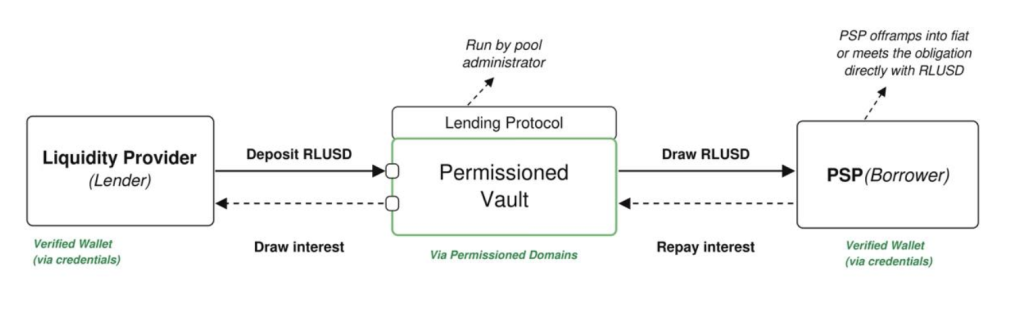
How the XRPL Lending Protocol Will Work
Rather than building another standalone lending application, Ripple wants the protocol to become the core credit infrastructure for the XRP Ledger.
The idea is fairly straightforward.
The blockchain would handle the enforcement of lending rules and loan mechanics, while financial institutions would continue making the decisions that require human judgment, such as evaluating borrowers, determining creditworthiness, setting loan terms, and complying with regulatory requirements.
In other words, Ripple isn’t trying to replace traditional lending departments.
As the company explained, blockchains are excellent at consistently enforcing predefined rules, but responsibilities like legal documentation, compliance reviews, and credit assessments still belong off-chain, where institutions can properly manage risk.
That hybrid approach is intended to combine blockchain efficiency with the oversight expected in traditional finance.
Two Components Power the New System
The proposal introduces two core building blocks.
The first is the Single Asset Vault, which pools and manages deposits of a single asset.
The second is the Lending Protocol, which takes those pooled assets and issues loans according to predetermined lending terms and conditions.
Together, the two systems create a standardized framework that institutions can build on while maintaining flexibility over how credit decisions are made.
Ripple’s first planned use case focuses on short-term liquidity.
For example, payment providers holding reserves of RLUSD could temporarily borrow against incoming cross-border settlement payments instead of selling assets or drawing credit from a traditional bank.
That would allow institutions to unlock liquidity more efficiently while transactions are still settling.
Before becoming part of the XRP Ledger, however, both protocol components must receive approval from network validators through proposals known as XLS-65 and XLS-66.

Ripple Is Targeting Institutional Adoption
Ripple made it clear that the lending protocol is being built primarily for institutional participants rather than retail DeFi users.
Existing lending platforms like Aave, Compound, Maple, and Clearpool already offer decentralized borrowing, but Ripple argues those systems were designed around crypto-native governance models that don’t always fit traditional financial institutions.
Permissioned lending platforms exist today, but Ripple says they often suffer from limited liquidity and smaller pools of counterparties because participation is restricted.
Its proposed solution attempts to bridge those worlds.
By standardizing lending infrastructure directly at the protocol level while keeping the network public, institutions could potentially access broader liquidity without giving up permissioned participation when compliance rules require it.
The result would be a lending framework that combines public blockchain infrastructure with enterprise-grade controls.
XRPL Foundation Expands Lending Push
Ripple’s announcement comes alongside another notable development for the XRP Ledger ecosystem.
The XRPL Foundation revealed a new partnership with VS1, a tokenization and yield platform built on XRPL.
Under the collaboration, VS1 will develop an open-source reference application focused on permissioned and compliant lending across the network. The project is expected to serve as a practical example of how regulated lending solutions can operate on XRPL once the new infrastructure becomes available.
The two announcements together highlight Ripple’s broader ambition to position the XRP Ledger as a blockchain capable of supporting institutional finance beyond simple payments.
Investors appeared to welcome the news.
XRP climbed roughly 2% following the announcements, although the token remains under pressure overall and is still down around 21% over the past month as broader weakness continues across the cryptocurrency market.
If the lending protocol ultimately receives validator approval, it could mark one of the XRP Ledger’s most significant infrastructure upgrades in recent years, opening the door to a more complete on-chain financial ecosystem for institutional users.
Disclaimer: BlockNews provides independent reporting on crypto, blockchain, and digital finance. All content is for informational purposes only and does not constitute financial advice. Readers should do their own research before making investment decisions. Some articles may use AI tools to assist in drafting, but every piece is reviewed and edited by our editorial team of experienced crypto writers and analysts before publication.









 English (US) ·