
 2 months ago
63
2 months ago
63
- More than 140 companies have joined forces to launch Open USD (OUSD), a new stablecoin built on Solana.
- Partners include Visa, Stripe, Mastercard, American Express, Coinbase, Ripple, Bybit, and Solana.
- Open USD aims to offer free minting and redemptions while sharing reserve income with participating businesses.
A coalition of more than 140 companies has announced the launch of Open USD (OUSD), a new stablecoin that will debut natively on the Solana blockchain later this year. The initiative brings together some of the world’s largest payment providers, financial institutions, and crypto companies, making it one of the most ambitious stablecoin projects announced to date.
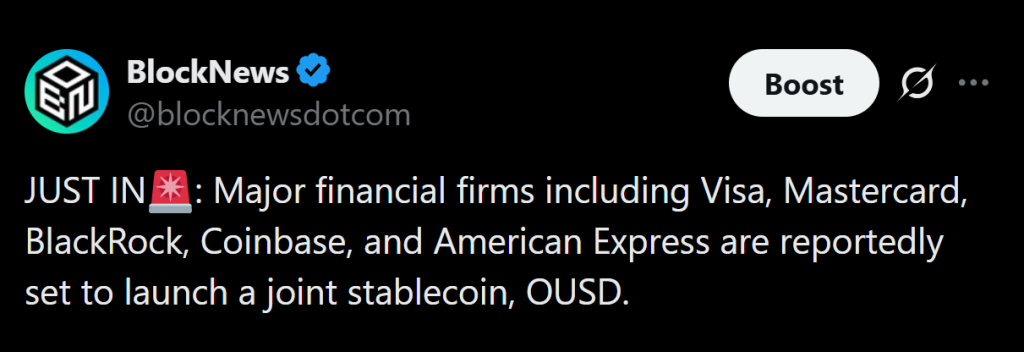
Among the founding partners are Visa, Stripe, Mastercard, American Express, Coinbase, Ripple, Bybit, and Solana, reflecting growing institutional confidence in blockchain-based payments and digital dollar infrastructure.
Open USD Is Taking a Different Approach
Unlike many existing stablecoins, Open USD will not be controlled by a single issuer. Instead, it will be owned and operated through an independent organization called Open Standard, with governance shared among participating partners.
According to founding CEO Zach Abrams, the project was designed to solve several challenges businesses face when using today’s stablecoins, including minting and redemption fees, limited access to reserve income, and dependence on a single company’s roadmap.
Under the proposed model, businesses will be able to mint and redeem OUSD at no cost, with no artificial volume limits. Reserve earnings generated by the stablecoin will also be shared among participating partners rather than retained by a single issuer.
Solana Chosen as the Native Blockchain
Open USD will launch natively on Solana from day one, highlighting the network’s growing reputation as a high-speed, low-cost blockchain capable of supporting large-scale payment infrastructure.
The decision represents another major institutional milestone for Solana, which has increasingly attracted payment companies, tokenization projects, and enterprise blockchain applications seeking fast settlement and low transaction fees.
If adoption accelerates as expected, Open USD could significantly expand activity across the Solana ecosystem.
Stripe Plans to Make OUSD Its Default Stablecoin
One of the biggest announcements came from Stripe, which said it intends to make Open USD its default stablecoin for businesses using its platform.
Stripe President of Technology and Business Will Gaybrick said businesses require a stablecoin capable of supporting global-scale commerce for decades to come, arguing that Open USD was designed not only for today’s economy but for the much larger digital economy expected in the future.
Support from Stripe could significantly accelerate institutional adoption by exposing millions of businesses to the new stablecoin through existing payment infrastructure.
Stablecoin Market Continues to Expand
The launch comes as stablecoins continue experiencing rapid growth across the financial industry. According to market data, the total stablecoin market has already approached $300 billion, with increasing adoption from banks, payment providers, fintech companies, and institutional investors.
BNY Chief Product and Innovation Officer Carolyn Weinberg recently projected that the stablecoin sector could grow to approximately $1.5 trillion by 2030. She said a neutral governance model combined with shared economics could help unlock the next stage of digital asset adoption.
As traditional finance continues embracing blockchain technology, Open USD’s broad coalition of financial and crypto companies could position it as one of the industry’s most closely watched stablecoin initiatives over the coming years.
Disclaimer: BlockNews provides independent reporting on crypto, blockchain, and digital finance. All content is for informational purposes only and does not constitute financial advice. Readers should do their own research before making investment decisions. Some articles may use AI tools to assist in drafting, but every piece is reviewed and edited by our editorial team of experienced crypto writers and analysts before publication.







 English (US) ·