
 3 months ago
41
3 months ago
41
- Platforms introduce insider trading bans as institutional access grows
- Lawmakers push new restrictions alongside market expansion
- Influence and capital convergence is raising regulatory concerns
Prediction markets are starting to feel very different, and not just because of growth. Platforms like Kalshi and Polymarket are now rolling out insider trading restrictions, banning users from betting on outcomes they can directly influence while introducing monitoring systems to flag suspicious activity. On its own, that might seem like a natural evolution. But the timing… feels a bit too precise to ignore.
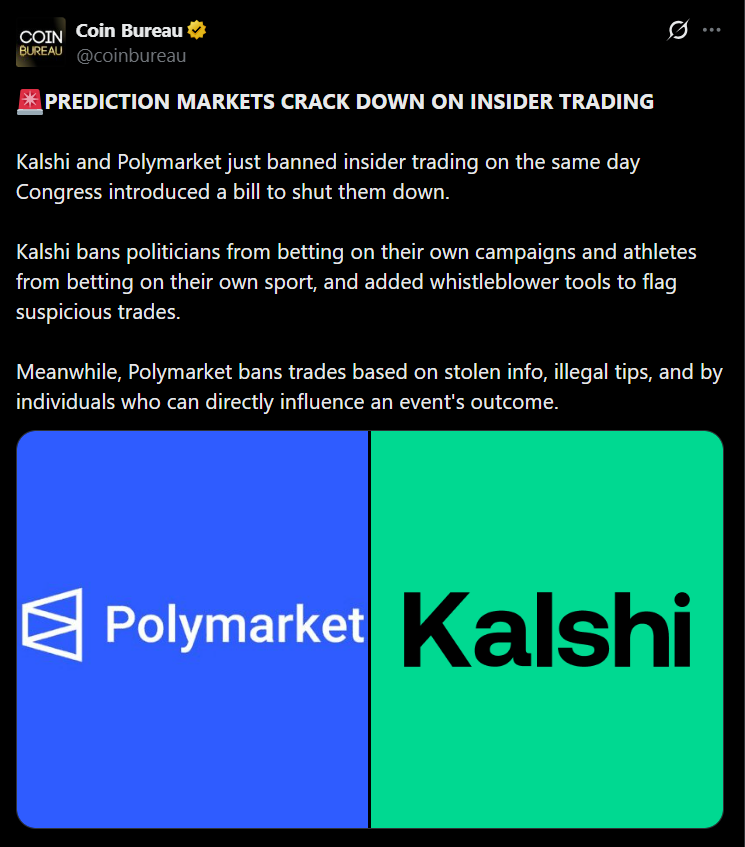
These rule changes arrived at the same moment lawmakers began pushing legislation aimed at limiting parts of the prediction market space. What looks like a series of isolated updates is starting to resemble something more coordinated, or at least more reactive than proactive.
The Model Starts to Crack Under Scale
Prediction markets are built on a simple idea, aggregate information into price. The assumption is that participants act as independent observers, each contributing their view of probability. But that assumption doesn’t always hold, especially as these markets grow.
Some participants sit closer to outcomes than others. Whether it’s political insiders, industry operators, or well-connected capital, access to information isn’t evenly distributed. And when those advantages meet liquid markets, the dynamic shifts.
Influence and Incentives Begin to Overlap
The real concern isn’t just information asymmetry, it’s influence. When participants have the ability, even indirectly, to shape the outcomes they’re betting on, prediction markets stop being purely observational.
That doesn’t mean manipulation is happening at scale, but it does mean the potential exists. And regulators tend to step in before that line is clearly crossed, not after.
Institutional Access Changes the Equation
This is where things accelerate. As institutional players enter through platforms and infrastructure providers, the size and sophistication of capital increases dramatically. These aren’t casual participants. They bring strategy, scale, and in some cases, proximity to the systems being priced.

At the same time, platforms introducing safeguards suggests they’re aware of what’s coming. Growth is good, but uncontrolled growth, especially with institutional money, can create risks that are harder to manage later.
Regulation Is Catching Up in Real Time
The introduction of new rules and simultaneous legislative action signals something important, oversight is no longer hypothetical. It’s happening in real time. As prediction markets become more relevant, they attract the same scrutiny as traditional financial systems.
And once regulation enters the picture, the tone changes. What was once experimental becomes structured, monitored, and, to some extent, constrained.
A More Complex Phase Is Beginning
Prediction markets aren’t breaking, but they are evolving. The entry of institutional capital, combined with growing regulatory attention, is pushing them into a more mature and more complicated phase.
It’s no longer just about betting on outcomes. It’s about understanding who participates, how influence plays a role, and where the boundaries are being drawn. And as those layers build, the space becomes less straightforward, but arguably more important than before.
Disclaimer: BlockNews provides independent reporting on crypto, blockchain, and digital finance. All content is for informational purposes only and does not constitute financial advice. Readers should do their own research before making investment decisions. Some articles may use AI tools to assist in drafting, but every piece is reviewed and edited by our editorial team of experienced crypto writers and analysts before publication.









 English (US) ·