
 1 hour ago
15
1 hour ago
15
- Strategy now holds more than 847,000 Bitcoin, but BTC trading below $60,000 has pushed the company’s shares below the value of its holdings.
- Falling prices are shifting the financial burden onto shareholders, bondholders, and even passive index investors.
- While no liquidation threat exists today, a key debt repayment due in September 2027 could become the company’s defining moment.
Strategy, formerly known as MicroStrategy, has built the largest corporate Bitcoin treasury in the world. That strategy looked brilliant while Bitcoin climbed. Now, with BTC slipping below $60,000, investors are beginning to ask a different question.
It’s no longer about whether Strategy will be forced to liquidate tomorrow.
Instead, the focus has shifted toward who ultimately bears the cost if Bitcoin remains weak while the company continues buying, borrowing, and holding.
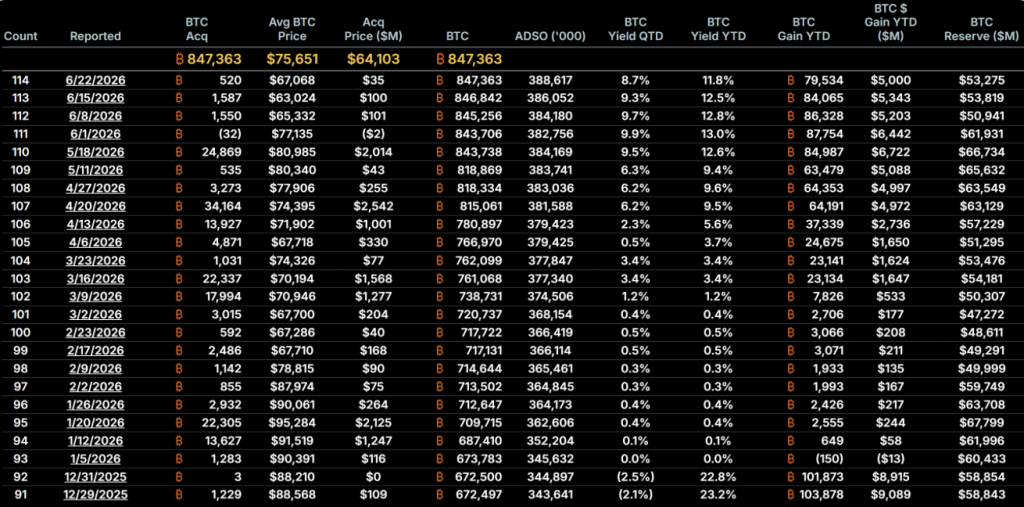
How Strategy Built Its Massive Bitcoin Position
As of June 22, Strategy owned 847,363 Bitcoin acquired for roughly $64.1 billion, giving the company an average purchase price of $75,651 per BTC.
No public company comes close.
Its approach has been relatively straightforward. Strategy raises capital through stock offerings and debt issuance, then uses those proceeds to purchase even more Bitcoin. When BTC rises, the company’s shares often outperform the cryptocurrency itself because investors assign additional value to its growing treasury.
The opposite also happens.
When Bitcoin falls, the entire mechanism begins working against shareholders.
BTC recently dropped below $60,000 for the first time since 2024, dragging Strategy shares lower in the process. The stock now trades below the value of the Bitcoin sitting on its balance sheet.
A new accounting rule has made those swings impossible to ignore.
Beginning in 2025, Financial Accounting Standards Board rule ASU 2023-08 requires companies to value their Bitcoin holdings at current market prices every quarter. That change led Strategy to report an unrealized loss of $14.46 billion during early 2026, contributing to a net quarterly loss of $12.54 billion, or $38.25 per diluted share.
Who Pays When the Bitcoin Strategy Slows Down?
While Strategy remains the face of the trade, the financial impact stretches well beyond the company itself.
The first group to feel the pressure is common shareholders.
Even when the stock trades close to—or below—the value of its Bitcoin holdings, Strategy can continue issuing new shares to raise cash for additional purchases. The downside is dilution.
Each new stock sale gives existing investors a smaller ownership stake while raising less value relative to previous offerings.
Michael Saylor acknowledged this during the company’s first-quarter 2026 earnings call, explaining that issuing stock when shares trade around net asset value actually reduces shareholder yield rather than creating it.
The second group includes investors who bought shares in newer Bitcoin treasury companies.
Many of those firms traded at substantial premiums to the value of their Bitcoin holdings during the market’s strongest periods. As excitement cooled, several of those premiums disappeared, causing treasury-company stocks to fall much faster than Bitcoin itself.
BitMine Chairman Tom Lee questioned whether the unwind already represented the bursting of a speculative bubble as many treasury stocks slipped below their underlying asset value.

Index Funds and Bondholders Could Face Pressure Too
Not everyone invested in Strategy intentionally.
MSCI recently proposed removing companies whose digital assets account for more than half of their total assets from several global equity indexes. Strategy comfortably exceeds that threshold.
If the proposal is adopted, index funds and pension managers tracking those benchmarks could be forced to sell their holdings automatically regardless of market conditions.
That would introduce another potential source of selling pressure, unrelated to Bitcoin’s actual price.
Convertible bondholders and preferred shareholders also remain an important part of the picture.
Many of those investors purchased Strategy’s debt believing the company would always have access to fresh financing. If Bitcoin remains depressed for an extended period, refinancing could become more difficult.
Strategy has previously indicated that Bitcoin sales could eventually be used to fund preferred dividend payments if necessary.
That possibility highlights an important shift in the company’s messaging.
Although Michael Saylor has repeatedly emphasized Strategy’s commitment to accumulating Bitcoin, management has also acknowledged that selling coins could become an option if doing so benefits the business.
Co-CEO Phong Le has made it clear the company isn’t committed to a permanent “never sell” philosophy under every circumstance.
September 2027 Could Become Strategy’s Defining Moment
Despite growing concerns, Strategy does not face an immediate liquidation risk.
Unlike past financing arrangements secured directly by Bitcoin, much of its current debt consists of unsecured convertible notes. That means a falling Bitcoin price alone cannot trigger forced asset sales.
The real deadline sits on the calendar.
On September 15, 2027, holders of roughly $1.01 billion in convertible notes gain the right to request repayment. If Strategy’s stock remains below the conversion price at that point, the obligation could become a sizeable cash payment instead of an equity conversion.
The company has navigated similar challenges before.
Back in 2022, a Bitcoin-backed loan from Silvergate carried a potential margin call near $21,000 before Strategy chose to repay the debt early. Since then, management has shifted toward unsecured financing structures, reducing immediate liquidation risks while still leaving future repayment obligations in place.
Some companies have already taken a different approach.
One Nasdaq-listed Bitcoin treasury firm recently sold part of its Bitcoin holdings to reduce debt, a decision that was welcomed by investors and sent its stock price higher. That has sparked broader discussions about how much liquidity companies like Strategy could realistically access if large Bitcoin sales ever became necessary.
For now, Strategy’s biggest challenge isn’t today’s Bitcoin price.
It’s time.
As long as financing remains available, the company can continue executing its long-term Bitcoin strategy. But if market conditions remain weak heading into September 2027, investors may finally discover whether the world’s largest corporate Bitcoin holder can keep its flywheel spinning—or whether reality eventually catches up.
Disclaimer: BlockNews provides independent reporting on crypto, blockchain, and digital finance. All content is for informational purposes only and does not constitute financial advice. Readers should do their own research before making investment decisions. Some articles may use AI tools to assist in drafting, but every piece is reviewed and edited by our editorial team of experienced crypto writers and analysts before publication.









 English (US) ·