
 1 month ago
44
1 month ago
44
- The IMF says advanced AI models are making cyberattacks cheaper, faster, and more dangerous
- Officials warned financial system breaches are now considered “inevitable” rather than theoretical
- Crypto platforms face higher risks because they lack traditional financial safety nets and protections
The International Monetary Fund just issued one of its strongest warnings yet about the future of AI-driven cyberattacks, and honestly, the implications for crypto are pretty unsettling. In a new report released Thursday, the IMF warned that frontier AI models are rapidly lowering the time, cost, and technical expertise needed to exploit vulnerabilities across global financial systems.
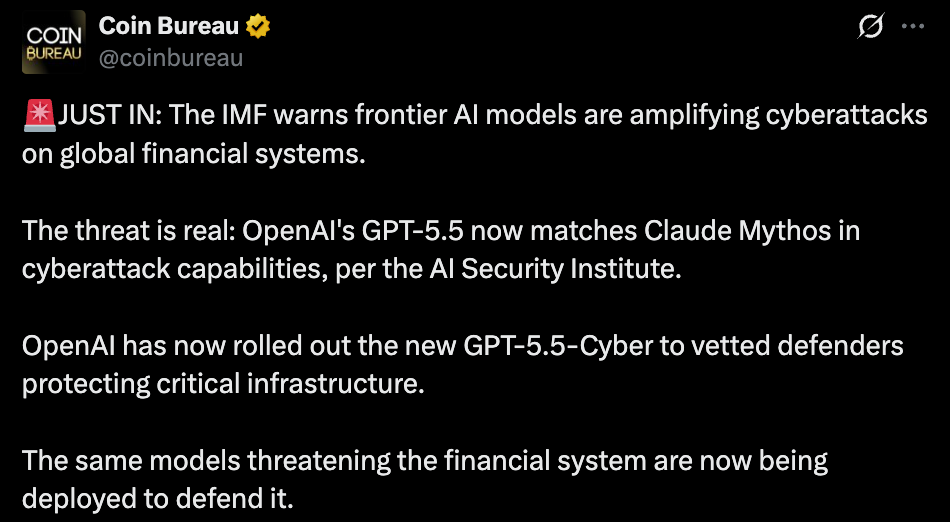
The report specifically highlighted AI’s growing ability to identify previously unknown “zero-day” flaws — the kind of vulnerabilities nobody even realizes exist until attackers are already actively exploiting them. And unlike typical cautious policy language, the IMF went a step further by describing future breaches as effectively “inevitable.”
That word matters. Institutions like the IMF rarely speak that directly unless they believe the risk is becoming unavoidable.
AI Is Making Cyberattacks Far More Dangerous
According to the IMF, advanced AI systems can dramatically accelerate both vulnerability discovery and exploitation across interconnected financial infrastructure. That includes everything from payment networks and banking systems to cloud providers and digital asset platforms.
The warning came only weeks after Anthropic reportedly cautioned that one of its upcoming AI systems, Mythos, showed unusual effectiveness at identifying hidden software vulnerabilities. That’s the kind of development security engineers quietly dread because it means AI may soon help attackers uncover weaknesses faster than humans can patch them.
And once AI tools become widely available, the barrier to launching sophisticated cyberattacks falls sharply. Highly skilled attackers are dangerous enough already. AI potentially gives similar capabilities to actors with far less technical expertise.
Shared Infrastructure Creates Massive Contagion Risk
One of the IMF’s biggest concerns revolves around systemic concentration risk. Financial institutions, exchanges, and blockchain companies increasingly depend on a relatively small number of cloud providers and shared infrastructure systems.
That means a single exploited weakness could ripple across multiple industries simultaneously. Yesterday’s Coinbase outage caused by overheating inside an AWS data center in Virginia was inconvenient but relatively harmless compared to what an intentional AI-assisted attack might look like targeting shared infrastructure directly.
The IMF warned these interconnected dependencies increase the risk of contagion spreading rapidly between platforms and institutions during major incidents. Bank of England Governor Andrew Bailey recently described frontier AI as something capable of “cracking the whole cyber risk world open,” which honestly sounds dramatic until you look at how centralized large parts of modern infrastructure actually are.
Crypto Has The Most To Lose
For crypto specifically, the risks become even more severe because the industry lacks many of the emergency protections traditional finance relies on during crises. Banks have deposit insurance, central bank liquidity support, decades of incident response coordination, and government backstops if things go catastrophically wrong.
Crypto generally has none of that.
A successful AI-assisted exploit against a major exchange, stablecoin issuer, or DeFi bridge could trigger immediate liquidity collapses, market-wide panic, token crashes, and cascading failures across connected systems. There’s no federal bailout waiting if billions disappear from a hacked protocol overnight.
DeFi protocols may be especially vulnerable because their smart contract code is publicly visible while simultaneously securing enormous pools of capital. In practice, that means attackers can study vulnerabilities openly before striking. AI simply accelerates that process dramatically.
AI Will Also Become Crypto’s Main Defense
The IMF did emphasize that AI itself may also become the best available defense against increasingly advanced attacks. Financial firms are already deploying AI systems to detect fraud, identify abnormal behavior, analyze vulnerabilities, and accelerate response times during incidents.
But the report stressed that AI-driven security only works if companies invest heavily in governance, oversight, audits, resilience planning, and operational discipline. In crypto, that likely means projects prioritizing formal verification, security audits, bug bounty programs, and infrastructure redundancy are no longer being overly cautious.
They’re adapting to reality faster than everyone else.
Because if the IMF is correct — and AI-assisted cyberattacks truly become inevitable — then the gap between secure crypto infrastructure and weak infrastructure could become brutally obvious very quickly. And honestly, some projects already look dangerously unprepared for what’s coming next.
Disclaimer: BlockNews provides independent reporting on crypto, blockchain, and digital finance. All content is for informational purposes only and does not constitute financial advice. Readers should do their own research before making investment decisions. Some articles may use AI tools to assist in drafting, but every piece is reviewed and edited by our editorial team of experienced crypto writers and analysts before publication.









 English (US) ·