
 2 months ago
64
2 months ago
64
- Major US labor unions are urging senators to oppose the upcoming crypto market structure bill
- The groups warn the CLARITY Act could expose retirement accounts and pensions to crypto volatility
- Banking groups are also lobbying against parts of the stablecoin provisions ahead of Thursday’s vote
The political fight around the CLARITY Act is getting louder just days before the Senate Banking Committee’s crucial vote. Several of the largest labor unions in the United States are now actively urging senators to oppose the crypto market structure bill, warning it could create risks for retirement accounts, pensions, and broader financial stability.
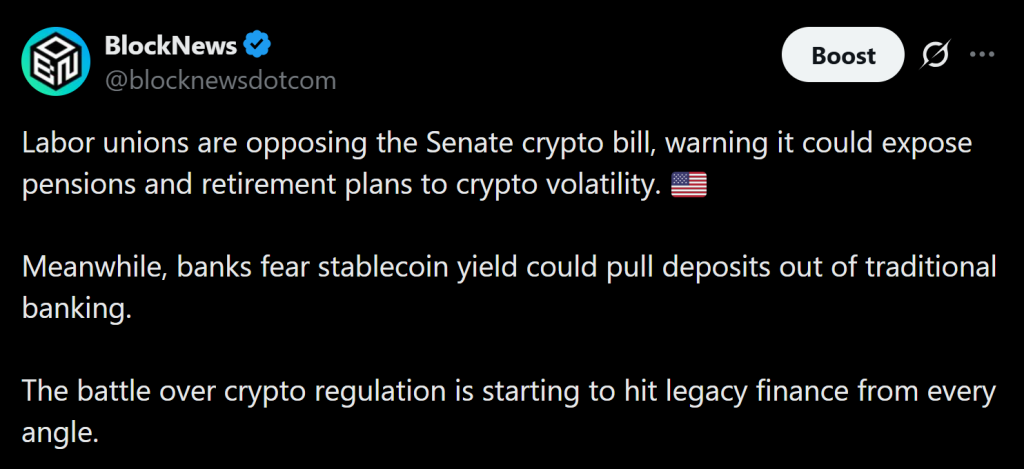
According to letters first reported by CNBC, organizations including the AFL-CIO, SEIU, American Federation of Teachers, National Education Association, and AFSCME argued the legislation could expose working Americans to excessive crypto-related volatility.
Labor Groups Say Workers Could Carry The Risk
In a joint letter reportedly sent to senators on Friday, the unions claimed the bill “jeopardizes the stability of workers’ retirement plans” while encouraging the crypto industry to take on outsized risks.
The groups argued that if crypto markets eventually face major failures or instability, ordinary workers and retirees could end up absorbing the damage rather than the firms benefiting from the industry’s growth.
The AFL-CIO separately warned Senate Banking Committee members that integrating cryptocurrencies and digital assets more deeply into the broader economy without stronger oversight could destabilize financial systems while disproportionately benefiting crypto issuers and platforms.
Stablecoins Remain A Major Flashpoint
At the center of much of the debate are stablecoin provisions inside the CLARITY Act. Banking industry groups are also lobbying aggressively against certain sections of the bill, arguing they could threaten traditional bank deposits if crypto firms eventually offer yield-like incentives tied to stablecoin holdings.

Crypto companies have pushed back strongly against those concerns, saying recent compromise language already bans stablecoin products from functioning like traditional interest-bearing bank accounts.
That compromise helped revive momentum around the legislation after months of delays earlier this year, but concerns from unions and banking groups show opposition remains significant heading into Thursday’s markup vote.
Democrats Still Appear Divided
Despite months of bipartisan negotiations, it remains unclear how many Democrats will ultimately support the legislation. Security concerns, ethics provisions, DeFi oversight language, and broader consumer protection questions continue dividing lawmakers internally.
As of Monday evening, final legislative text for the updated bill had still not been publicly released, adding even more uncertainty ahead of the committee vote.
Still, the CLARITY Act remains the most serious attempt yet to establish formal crypto market structure rules in the United States. If advanced by committee, the legislation would move toward a full Senate vote later this year.
The Crypto Regulation Battle Is Expanding
What’s becoming increasingly clear is that crypto regulation is no longer just a fight between regulators and the digital asset industry itself. Labor unions, banks, pension stakeholders, and political groups are now all actively trying to shape how crypto integrates into the broader financial system.
And honestly, that probably signals crypto has officially crossed into mainstream economic policy territory whether Washington is fully prepared for it or not.
Disclaimer: BlockNews provides independent reporting on crypto, blockchain, and digital finance. All content is for informational purposes only and does not constitute financial advice. Readers should do their own research before making investment decisions. Some articles may use AI tools to assist in drafting, but every piece is reviewed and edited by our editorial team of experienced crypto writers and analysts before publication.









 English (US) ·